Introduction
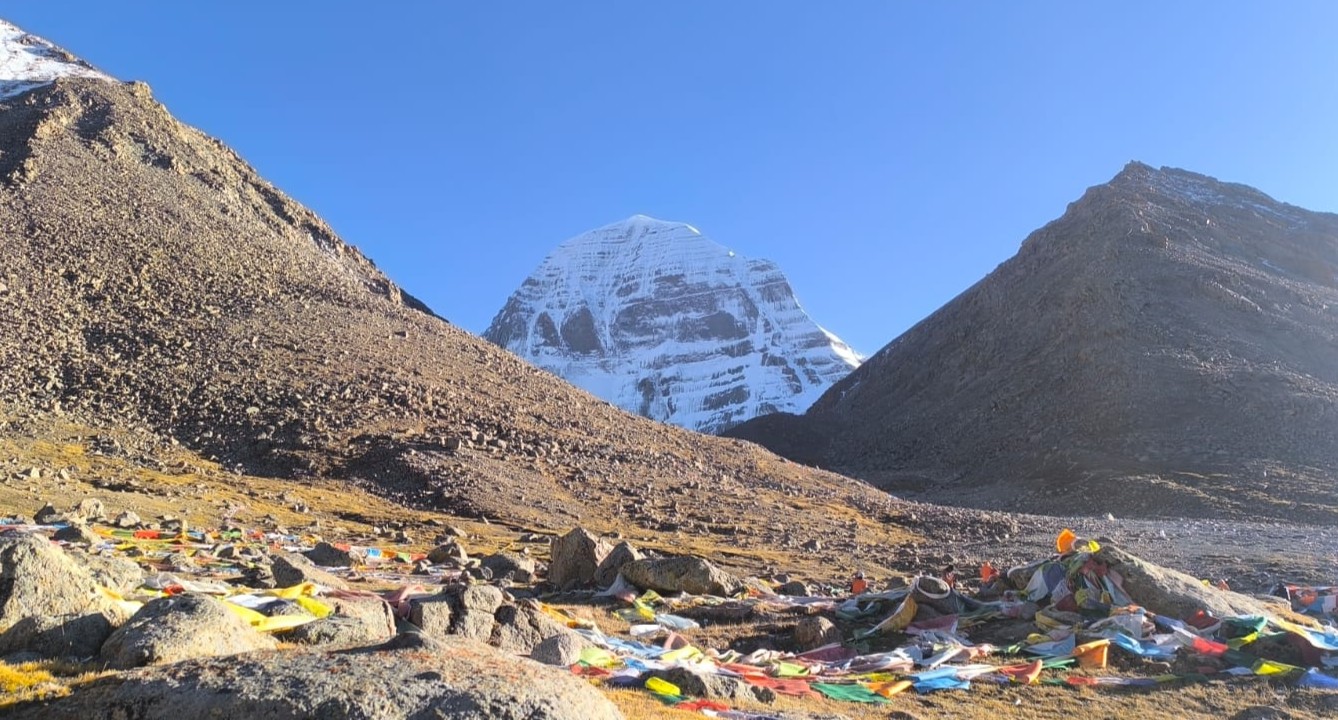
In the far southwestern corner of Tibet, within the vast and windswept Ngari region, rises one of the most mysterious and spiritually powerful mountains on Earth, Mount Kailash. Standing at 6,638 meters (21,778 feet), this striking black-rock pyramid crowned with snow is not the tallest Himalayan peak, yet it is widely regarded as the most sacred mountain in the world.
Unlike other Himalayan giants, Mount Kailash has never been climbed. It remains untouched, revered, and protected by faith. For thousands of years, pilgrims from across Asia have journeyed here not to conquer its summit, but to walk humbly around its base in devotion. This journey, known as the Kailash Mansarovar Yatra, is considered one of the most profound spiritual experiences on the planet.
In spiritual cosmology, Kailash is believed to be the earthly manifestation of Mount Meru, the mythical cosmic mountain described in ancient scriptures as the center of all universes. To devotees, this is not metaphor. It is reality.
Whether you are planning your yatra to Kailash Mansarovar or simply seeking to understand its sacred aura, this guide covers everything from geography and legends to practical travel advice.
The Geography and Unique Structure of Mount Kailash
Mount Kailash rises dramatically from the Tibetan Plateau, isolated from other Himalayan peaks. Its four nearly symmetrical faces align almost perfectly with the four cardinal directions. Vertical striations on the south face create the appearance of a massive staircase, and under certain lighting conditions, natural shadows resemble a swastika, an ancient symbol of auspiciousness.
Geologically, Kailash consists of metamorphic and sedimentary rock layers formed millions of years ago. Despite scientific explanations, the mountain’s symmetry continues to inspire spiritual interpretations.
The region surrounding Kailash is equally significant. Four major rivers of Asia originate near this sacred zone:
- Indus River
- Sutlej River
- Brahmaputra (Yarlung Tsangpo)
- Karnali River
This convergence reinforces Kailash’s identity as the “Water Tower of Asia” and strengthens its symbolic role as the life-giving center of the continent. Pilgrims undertaking the yatra Kailash Mansarovar witness firsthand the power of these waters and their spiritual symbolism.
Lake Mansarovar: The Sacred Mirror of the Divine
South of Mount Kailash lies Lake Mansarovar, one of the highest freshwater lakes in the world at 4,590 meters above sea level. Its crystal-clear turquoise waters reflect the sacred peak, creating a scene of almost unreal beauty.
In Hindu belief, Lake Mansarovar was first created in the mind of Lord Brahma before manifesting physically. Bathing in its waters is believed to cleanse sins accumulated over lifetimes, making it a central highlight of the Kailash Mansarovar Yatra. For Buddhists, the lake represents clarity of enlightened awareness. Jains see it as a symbol of spiritual purification.
For practical travelers, the lake also serves as a place to rest and acclimatize before beginning the challenging yatra. Its serene environment makes it ideal for meditation and reflection.
Ancient References in Sacred Texts
Mount Kailash appears in some of the oldest known scriptures.
- Hinduism: The Rigveda (1500–1200 BCE) describes Mount Meru as a cosmic axis adorned with divine brilliance. Later Hindu Puranas portray Kailash as the eternal abode of Lord Shiva, where he resides in meditation with Goddess Parvati. The sacred Ganga River is said to have descended from Shiva’s matted locks at this very site.
- Buddhism: In Tibetan Buddhist texts, Kailash is known as Kang Rinpoche, the “Precious Snow Jewel.” It is described as the mandala palace of Demchok (Chakrasamvara), representing ultimate bliss.
- Jainism: Kailash, called Ashtapada, is the site where Rishabhadeva, the first Tirthankara, attained liberation.
- Bon Religion: Predating Buddhism in Tibet, Bon reveres Kailash as Yungdrung Gutsek, the Nine-Story Swastika Mountain, symbolizing eternal truth.
Few places on Earth unite so many spiritual traditions. For more on this, you can read Kailash myths and facts.
The Unclimbed Summit: A Sacred Prohibition
Mount Kailash remains unclimbed. British explorer Hugh Ruttledge withdrew from attempting the summit out of respect for its sanctity. Later, mountaineer Reinhold Messner also declined. Today, climbing Kailash is officially prohibited.
This unique protection highlights a profound truth: the mountain is a site of devotion, not conquest. The Kailash Mansarovar Yatra Package focuses on circumambulation, meditation, and spiritual reflection rather than mountaineering.
The Sacred Kora: Walking Around the Universe
Instead of climbing, pilgrims perform the Kora—a 52-kilometer circumambulation around Mount Kailash. This ritual is considered one of the most powerful acts of spiritual purification.
- Completing one Kora is believed to erase a lifetime of sins.
- Completing 108 Koras can lead to ultimate enlightenment.
The path crosses valleys, glacial streams, and the high Dolma-La Pass at 5,630 meters, symbolizing death and rebirth. Devout pilgrims often perform the circuit with full-body prostrations—a physically demanding act that may take weeks. Each step represents surrendering ego and past karma.
Travelers interested in this journey can explore detailed Kailash Mansarovar tour packages offering guided support, accommodation, and logistical planning for the Kora.
Festivals and Sacred Energy
Saga Dawa: Commemorates the birth, enlightenment, and parinirvana of Buddha. Thousands of pilgrims undertake the Mansarovar Kailash Yatra during this festival, amplifying the spiritual merit of their journey.
Maha Shivaratri: Celebrates Lord Shiva. Pilgrims from Nepal and India gather at Pashupatinath Temple before the journey. Participating in the festival strengthens the spiritual intention of the yatra to Kailash Mansarovar. For more details, see Mahashivaratri festival.
Climate and Environment
The Kailash region features a high-altitude desert climate with extreme temperature variations. Thin air, low oxygen, and sudden weather changes challenge every pilgrim. Days may be sunny, while nights drop well below freezing.
Despite harsh conditions, the plateau offers stunning vistas: vast open plains, endless skies, and distant snow-capped peaks. Wildlife like wild yaks, Tibetan antelope, and migratory birds inhabit the region. Its remoteness ensures a spiritual atmosphere largely untouched by modern development.
Planning Your Kailash Mansarovar Yatra
- Kailash Mansarovar Yatra Package India: Organized trips from major Indian cities with visa assistance and logistical support.
- Kailash Mansarovar Yatra Tour: Complete itineraries covering Lake Mansarovar, Kora, and key pilgrimage spots.
- Cost of Kailash Mansarovar Yatra: Costs vary depending on package inclusions, duration, and mode of travel. Packages typically cover travel, permits, accommodations, and guides.
These packages simplify the journey, allowing pilgrims to focus on spiritual practice rather than logistics.
Spiritual Transformation and Inner Journey
The Kailash Mansarovar Yatra is a profound inner journey. Pilgrims often describe life-changing experiences:
- Physical hardship strips away comfort.
- Altitude humbles the body.
- Silence and vastness quiet the mind.
Kailash becomes less a mountain and more a mirror, reflecting fears, attachments, and faith. Pilgrims return transformed, often realizing that the true summit lies within.
Why Mount Kailash Endures as the Axis Mundi
Mount Kailash is not simply a destination. It is the archetype of sacred geography. Across cultures, the idea of a cosmic mountain connecting heaven and earth appears repeatedly. Kailash stands as perhaps the most enduring example of this symbol in physical form.
It remains unclimbed, revered, and a beacon for spiritual seekers worldwide. To visit Mount Kailash is to step into a living myth, where natural grandeur, ancient stories, and faith converge into one of the most powerful pilgrimage experiences on Earth.
For travelers and devotees, whether you seek spiritual purification, adventure, or insight, the yatra Kailash Mansarovar promises an unforgettable journey that reshapes the mind and soul.